For AI teams and health AI founders
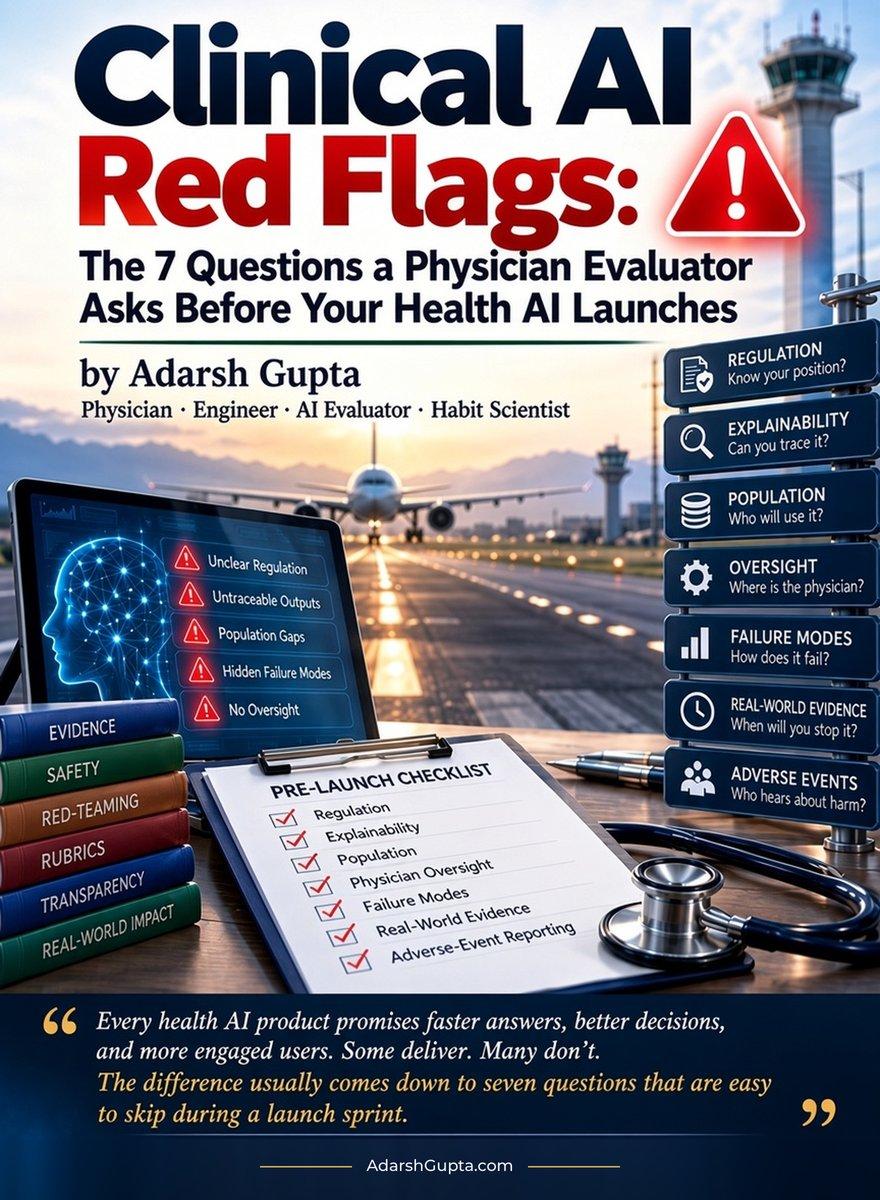
Clinical AI Red Flags: The 7 Questions a Physician Evaluator Asks Before Your Health AI Launches
This guide is for AI evaluation and data companies, health AI startups and consumer health apps, and teams adding health features to AI products. Clinicians are welcome to read along. It is the checklist I bring to an evaluation, written so a team can run it first. It is not medical, legal, or regulatory advice for a specific product.
Adarsh Gupta · Physician · Engineer · AI Evaluator · Habit Scientist · adarshgupta.com
What it covers
Seven questions
Every health AI product promises faster answers, better decisions, and more engaged users. Some deliver. Many don't. The difference usually comes down to seven questions that are easy to skip during a launch sprint. Each question in the PDF covers what I probe, what a red flag looks like, what good looks like, and a test you can run before launch. This page is the summary. The full guide is the PDF.
1. Do you know what your product is, legally, and does your marketing agree?
Intended use, who the user is, and whether the website, the app store, and the interface match the regulatory position the team says it holds.
2. Can a qualified person trace an output back to its basis?
What drove the answer, and whether a clinician or user can check it against the chart, the guideline, or the cited paper.
3. Does your evaluation data look like the people who will use the product?
Who is in the training and test data, and how that compares with who will actually show up, especially when anyone can download a consumer app.
4. Where does qualified human judgment sit, and what happens without it?
Every point where the system can message someone, escalate, change a plan, or write into a record, and how a consumer product hands off when no clinician is in the loop.
5. Can you describe how the model fails, not just how it scores?
The weakest subgroups and scenarios, a walk-through of a false negative, and the error taxonomy the team actually uses.
6. What will tell you the product works outside the lab, and when will you stop it?
Whether any results come from routine use, and, before launch, the written plan for what will be measured, against what baseline, and what would trigger a pause.
7. When the product contributes to harm, how do you find out, and what changes?
How a user or clinician reports a harmful, misleading, or delayed output, who triages it, and whether a report has ever changed the model, the prompt, or the product.
Get the guide
Email required — then the PDF
Signup emails the PDF and adds you to the biweekly Clinical AI Brief.
How I can help
Clinical AI evaluation consulting, scoped to the work you need. Red-teaming, rubric design, response evaluation, and safety review are one engagement. The written scope names which of these apply before work begins.
Book a free discovery callGeneral educational information. Not legal, regulatory, or medical advice for a specific product, and not an endorsement of or recommendation against any named product. Pair evidence questions with CertaintyGrade, which is Early access. GRADE is not a blanket AI-model score or a regulatory certification.